Antimicrobial Floor Coatings: The Contamination Defense You Can’t Afford to Skip

Contamination events in food facilities rarely start in the air or on equipment. They start on the floor. Floors collect organic debris, accumulate moisture, and provide warm protected recesses where pathogens establish and multiply. Then foot traffic, equipment wheels, and air movement distribute those pathogens throughout the facility. Addressing floor contamination risk isn’t a secondary concern in food safety planning. It’s primary.
Antimicrobial food service flooring from High Performance Systems addresses contamination at the source, starting at the floor level, where most sanitation failures originate.
What Makes a Floor Coating Antimicrobial?
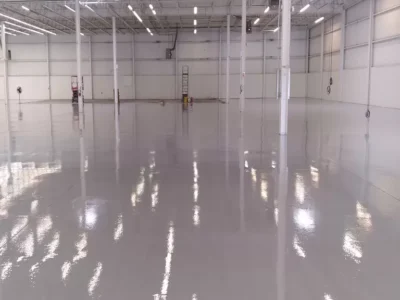
An antimicrobial floor coating works in two ways. The first is physical elimination of harborage points. A seamless, non-porous surface with no joints, cracks, or grout lines removes the environmental conditions bacteria need to establish and survive. The second mechanism involves the surface chemistry of the coating itself, which inhibits microbial attachment and biofilm formation even on the exposed surface.
High Performance Systems installs antimicrobial, non-porous coatings that combine both mechanisms. The result is a surface that doesn’t just resist cleaning and sanitation chemicals, but actively impedes the microbial colonization that makes contamination events possible.
How Does This Relate to USDA and FDA Compliance?
USDA and FDA floor standards for food facilities are essentially a regulatory expression of basic microbiology. Regulators require seamless, non-porous surfaces because science clearly shows that porous, jointed surfaces harbor pathogens that cleaning programs cannot reliably eliminate. Compliant food and beverage flooring isn’t just meeting a regulatory checkbox, it’s implementing a scientifically validated contamination prevention strategy.
When your floor system is engineered to the same standard that regulators require, passing inspections stops being stressful and starts being routine.
Thermal Shock and Its Sanitation Implications
There’s a less obvious connection between thermal shock resistance and antimicrobial performance that most facility managers miss. When a floor cracks due to thermal stress during hot steam washdowns, each crack immediately becomes a bacterial harborage point. The hot water meant to sanitize the facility is simultaneously creating new contamination risk by damaging the floor surface.
A qualified urethane concrete contractor installs systems that handle thermal shock up to 250°F without cracking. This means your aggressive hot water sanitation program works as intended, sanitizing the floor rather than compromising it. That connection between thermal resistance and sanitation effectiveness is critical in high-washdown environments.
Meat and Poultry Processing: The Most Demanding Application
Meat and poultry processing floors face the full spectrum of challenges simultaneously. Organic acids from blood and fat attack standard coatings. Thermal shock from mandatory hot water sanitation cycles stresses every floor joint and surface transition. Heavy equipment traffic generates mechanical wear and impact stress. Wet conditions throughout the shift create constant slip hazard and moisture exposure.
Proper food service flooring for meat and poultry environments must address all of these factors at once. Urethane concrete installed by a certified contractor with food facility experience is the system most consistently specified for these applications, and for good reason.
Commissary Kitchens and Large-Scale Food Preparation
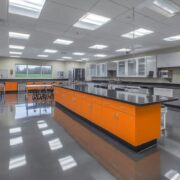
Large commissary kitchens present a different challenge profile. They typically see a wider variety of food types being processed simultaneously, creating diverse chemical exposure from acids, fats, proteins, and sugars all at once. High-traffic periods during production alternating with aggressive sanitation cycles mean the floor never gets much of a rest. And the scale of these operations means floor failure creates outsized operational disruption.
High Performance Systems has installed floor systems in large-scale commissary kitchen environments across the NJ, NY, and PA region. Their approach is always to assess the specific operational conditions before recommending a system, rather than defaulting to a one-size solution.
Bottling Plants and Beverage Facilities
Industrial bottling plants have their own specific floor chemistry challenges. Sugary beverage residue creates sticky surface contamination that promotes mold growth if not managed. Carbonated beverage production involves CO2 that creates slightly acidic washwater. High-speed production lines mean constant vibration stress on floor surfaces. And the speed of production in bottling facilities makes floor downtime exceptionally costly.
Seamless antimicrobial floor systems handle all of these variables. Smooth, non-porous surfaces don’t retain sugary residue, clean efficiently, and resist the mild acid exposure from carbonated beverage operations.
Why Contractor Certification Matters for Antimicrobial Systems
Antimicrobial floor systems are only as effective as their installation quality. Pin holes, surface inconsistencies, and inadequately prepared edges can compromise the seamless integrity that makes these systems work. High Performance Systems has been certified industrial contractors since 1988. Their installation process ensures the finished floor achieves the seamless, fully bonded surface that antimicrobial performance requires.
FAQs
How do antimicrobial floor coatings work in food facilities? They work by eliminating physical harborage points through seamless, non-porous surfaces that leave pathogens nowhere to anchor, and through surface chemistry that inhibits biofilm formation.
Are antimicrobial floor coatings required by USDA and FDA? The regulatory requirement is for seamless, non-porous surfaces that prevent bacterial harborage. Antimicrobial coatings that meet this standard satisfy USDA and FDA floor requirements for food processing and commercial kitchen environments.
Can these systems be installed without shutting down production? High Performance Systems engineers installations to minimize downtime. Scheduling and phased installation approaches can often keep portions of the facility operational during floor work.